Observations about Theodora, Urraca, Hypatia and Olympia in “Mirrors” by Galeano
Let me start by saying that “Mirrors: Stories of Almost Everyone” by Eduardo Galeano is one of the most eye-opening and easy-to-read novels one can read. If you don’t have a lot of time, yet still want to learn about the untold stories of people such as Hypatia and Alexandra through a compilation of essays, I suggest you buy or download a PDF of this book! 🙂
The novel sometimes has essay series, one of which is the one I will be analyzing today. (This series is for women to whom we owe a lot whose stories have been corrupted.) These are screenshots from the PDF (if you want me to share it with you, don’t hesitate to contact me).
The essay right below is called “Theodora”, the title didn’t fit into the page.
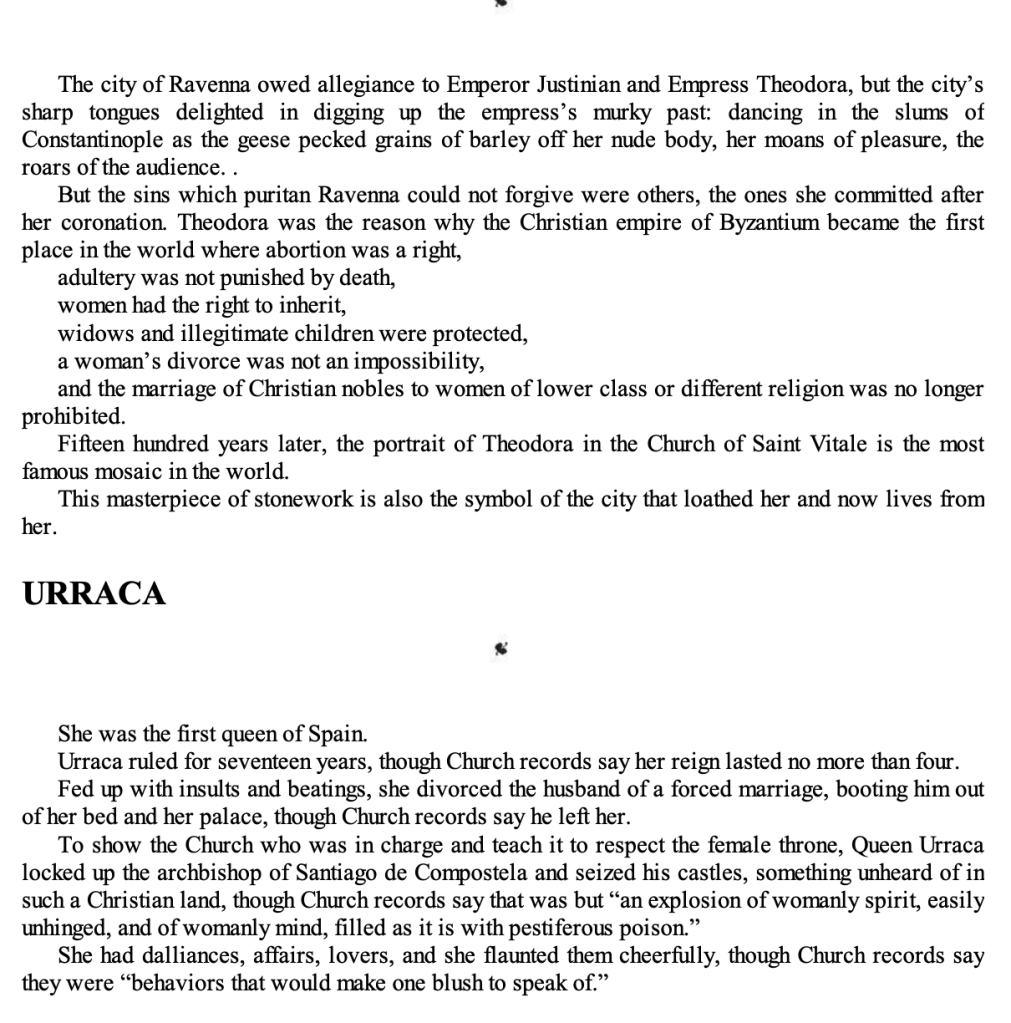
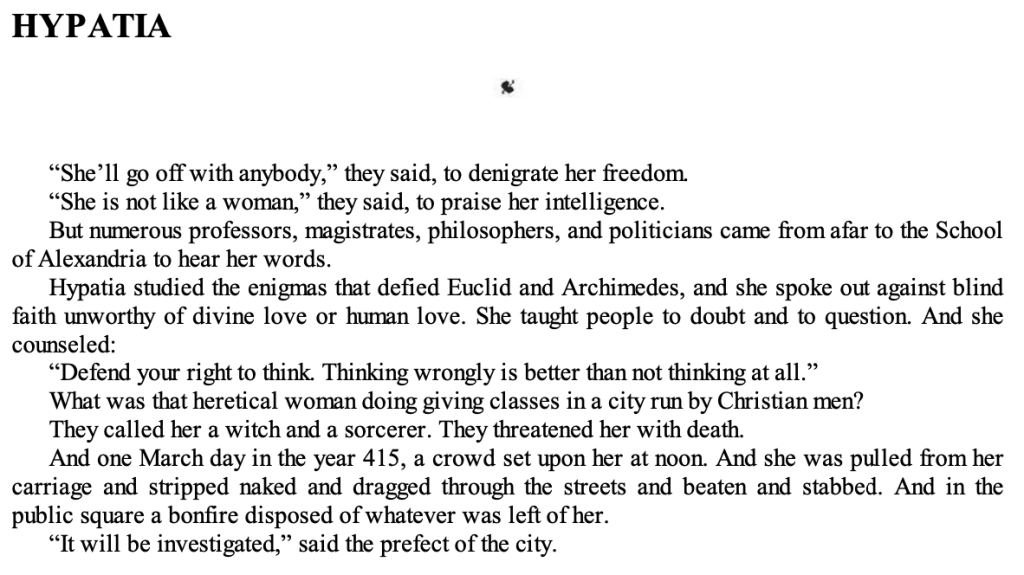

One of the most obvious patterns we can see in all of these essays is that throughout history, the credibility of women and the credibility of their ideals have been trivialized through the mentioning of their pasts. In Theodora, Galeano shows the reader that her ideals of legalizing abortion, protecting widows and illegitimate children, allowing divorce on the women’s part and such are made to seem like impossible ideals to the general public, ideas which have been proposed by a woman not meant to be taken seriously because of her “murky” past, though this would not be the case with men. Men who have “murky pasts” (though what is referred to as a “murky” past in Theodora’s case would be presented as a past to be proud of in the case of a male figure) and become influential are glorified for being able to balance the two and even encouraged to keep going, or called “now-family men who have fun pasts”. In Urraca, not only are her achievements completely untold or altered in the Church’s records, her dalliances and love affairs which she isn’t embarrassed of -unlike what is expected of her-, the ones she instead flaunts around cheerfully, is reflected in such a way in Church records that she seems to readers as a sex freak, someone who people should either be disgusted by or keep their distance from, though this would not be the case with men. In the case of a male leader, records would show that he stayed in power for seventeen years when he actually stayed for four, that he courageously did something unheard of and seized the castles of the archbishop, setting the path for success in Spain, and his “dalliances” wouldn’t even be mentioned, or if they were, they’d be mentioned as something to be proud of on the king’s part. In Hypatia, she’s called a “woman” when she dares to give lectures, ones that will possibly change the lives of people who will grow up to be world-renowned scientists uncovering the mysteries of the world, in a Christian male-dominated (not even male-dominated, completely male) community. She is, however, categorized as a “man” and called “one of a kind” when these lectures do end up changing the lives of others; or when she studies the enigmas that defied Euclid and Archimedes. Her identity is decided for her at her every move in a way that will be profitable on the part of the ones who hold power. (If you’re interested in Hypatia’s story more, I suggest you watch “Agora“, it’s a very good movie.) In Olympe, her rational statements are not even argued against, because they can’t be; she is instead executed, and her friends are sent to insane asylums. She states the obvious truth, asks the question perhaps gnawing at every child, woman, and citizens’ mind, though she is executed immediately after. Her story shows to the reader the obvious hypocrisy that exists in history: having female, bronze, or marble women as the figures for the Revolution but not even letting those said figures exist freely, creating a Declaration of Independence for “the Man and the Citizen”, leaving the title just vague enough to let women, “lesser” women; those they denied education and critical thinking to; to think that they have a say, whereas the term “citizen” in the declaration is simply another way of saying “men”.
The inequalities and hypocrisies that so unfortunately existed in the past still exist. We see patterns of hypocrisy in the media, in every single industry, and in our daily lives today. I love the way Taylor Swift talks about this in an interview. Here’s a short clip. As she says, there is, and always has been, a different vocabulary for men and women. Not only in the music industry but truly everywhere. Fortunately, more and more people are getting on board with abolishing these vocabularies and hypocrisies, but it’s still a long way until we get there. So in the meantime, here are some things you can do to speed up the journey:
- Research. This can be all kinds of research, ones done through essays such as the ones above, movies like Agora, interviews like the one Taylor Swift has done, feminist novels, or just plain research about the history of sexism and how it has evolved into what it is today. I believe such research allows one to internalize the issue and the long list of examples surrounding sexism since the beginning of time.
- Observe. Through observing others (and perhaps yourself/the way other people act towards you), you will be able to quickly see patterns of sexism. Sometimes, it’s not even a conscious act of sexism, some peoples’s internalized sexism runs so deep that they require more than one person’s observations and attempts at putting them in their place to get better.
- Act. Don’t be scared to act if someone does something sexist towards you or someone you care about. This can be an act of passive aggression, like speaking to them in a stern manner and explaining to them the sexist behaviors they’re exhibiting that harms both females and males all around the world every day, or it can be an active agression (straight up yelling and “throwing a fit”).
- Believe. Believe that it truly will get better, and be aware of your role in making it happen! 🙂
The world is a tough place for minorities to exist in sometimes, but it can all be improved and even solved through education, awareness creation or sometimes (though I don’t necessarily condone it, but choose to leave it to your judgement), through putting someone in their place.
 ECLECTIC OBSERVATIONS
Leave a comment